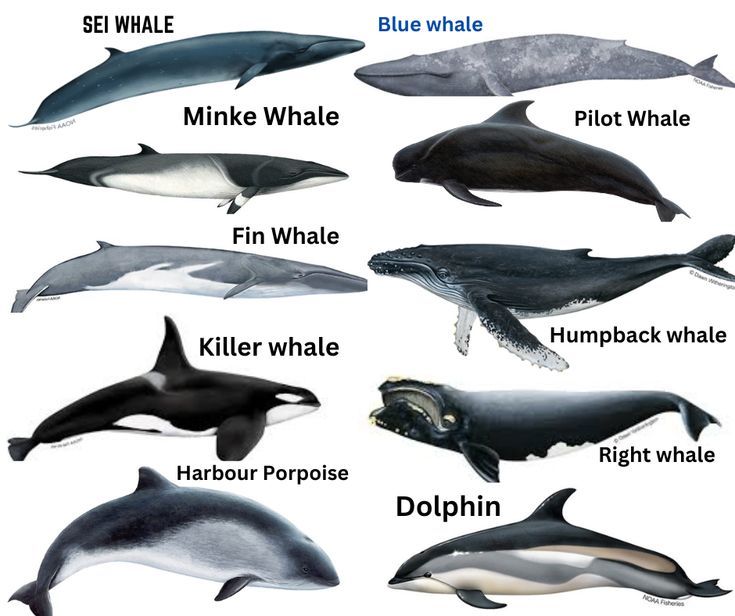
Sei Whale – The Sei whale is a fast, streamlined baleen whale known for its sleek dark body and tall curved dorsal fin. It feeds on small fish and plankton by skimming through dense patches of prey. In Nova Scotia, they are most often found offshore along the edge of the Scotian Shelf, particularly in deeper waters like the Gully Marine Protected Area and along the continental shelf break.
Blue Whale – The Blue whale is the largest animal on Earth, reaching lengths over 80 feet. It feeds almost exclusively on tiny krill and has a long, mottled blue-gray body. In Nova Scotia, blue whales are occasionally seen in deep offshore waters, especially in the Cabot Strait between Cape Breton and Newfoundland, and along the Scotian Shelf during summer feeding months.
Minke Whale – The Minke whale is the smallest of the baleen whales commonly seen here, with a pointed snout and a distinctive white band on its flippers. They are curious and often surface quickly. In Nova Scotia, minkes are frequently spotted close to shore in the Bay of Fundy, off Brier Island, and along the Atlantic coast during summer.
Pilot Whale – The Long-finned pilot whale is a large, dark member of the dolphin family with a bulbous forehead and social behavior, often traveling in tight pods. Around Nova Scotia, they are commonly found offshore, especially near the Gully and deep waters off eastern Cape Breton.
Fin Whale – The Fin whale is the second-largest whale in the world, recognized by its long, slender body and asymmetrical jaw coloration (white on the right side). Fast and powerful, fin whales are regularly seen in the Bay of Fundy, particularly near Grand Manan and Digby Neck, as well as offshore along the Scotian Shelf.
Humpback Whale – The Humpback whale is famous for its long pectoral fins, acrobatic breaches, and haunting songs. These whales migrate to Nova Scotia each summer to feed. They are commonly seen in the Bay of Fundy, around Brier Island, Cape Breton’s Cabot Trail coastline, and offshore banks.
Killer Whale – The Orca, also known as the killer whale, is actually the largest member of the dolphin family. With bold black-and-white markings and a tall dorsal fin, orcas are powerful predators. In Nova Scotia, sightings are less common but do occur offshore and occasionally in the Bay of Fundy.
Right Whale – The North Atlantic right whale is a critically endangered baleen whale identified by callosities (rough patches) on its head and lack of a dorsal fin. Nova Scotia’s Bay of Fundy and Roseway Basin (south of Halifax) are key feeding grounds in summer and early fall.
Harbour Porpoise – The Harbour porpoise is a small, shy marine mammal with a rounded face and triangular dorsal fin. Unlike dolphins, they rarely leap from the water. They are commonly found in coastal waters throughout Nova Scotia, especially in the Bay of Fundy and along the Atlantic shoreline.
Dolphin – The Atlantic white-sided dolphin is the most commonly seen dolphin species in Nova Scotia waters, known for its striking white and yellow side markings and energetic behavior. Large pods are often spotted offshore along the Scotian Shelf and occasionally closer to shore during feeding seasons.
 Exploring The Small Towns of Canada
Leave a comment